
Montgomery County Arrest Report Sources
Montgomery County publishes no 72-hour, weekly, or multi-day booking blotter. The sheriff's web pages carry none. The Sheriff's Office and Detention Services sections list contacts and jail facts. But they carry no public log or date filter. No online photo policy appears either. A current-custody call or a focused records request is the official route.
The Detention Center holds county bookings. It sits at 206 Glen Road in Troy. Call 910-576-4261 for current custody. Sheriff records can be raised at 910-572-1313 through the office at 111 West Main Street. Town police in Troy, Biscoe, and Mount Gilead keep the reports they wrote. A county booking does not move that record.
Read Montgomery Arrest Reports
Start every search with a date range and an agency. Then pull the pieces apart. Name each one: the arrest itself, jail intake, the court filing, and the news account. Dates can differ across them. Each record marks a different step. So work backward from the newest likely source rather than treating a missing web result as proof that no record exists.
- Set the exact date span and gather the full name, town, and likely arresting agency.
- Ask the detention center whether the person is now held or was booked during the period.
- Request the arrest or incident report from the agency that handled the event.
- Check North Carolina court records for filed charges and later disposition.
- Use dated official releases and newspaper archives as leads, then verify their claims.
Need a same-day answer? The Arrested Today page fits that job better. A multi-day search has a different aim, tracking delayed reports, weekend activity, and entries that have rolled out of any current-status tool.
Montgomery Arrest Report Fields
No county web table exists to copy here. Instead, these fields describe the useful parts of agency, booking, and news records, and why one entry never tells the full story.
| Field | How to read it |
|---|---|
| Name and identifiers | Confirm identity; similar names can produce false matches. |
| Event or arrest date | Marks police action, which may precede jail intake. |
| Booking date and time | Shows facility processing rather than the whole investigation. |
| Arresting agency | Points to the office that may hold the event report. |
| Charge as reported | States an charge at that stage, not a conviction. |
| Bond or release information | Can change after magistrate or court review. |
| Source and publication date | Shows when a release or article appeared, not when every event occurred. |
| Photograph | May be held as a record; no official county online display was verified. |
North Carolina G.S. 132-1.4 opens specified arrest facts to the public. Criminal-investigation material gets different treatment. Ask for a named record. The custodian should cite the basis for any denial or redaction.
Montgomery Weekend Report Gaps
Montgomery County keeps no weekend or holiday publishing schedule, because it runs no public blotter at all. Claims of a Monday surge or a fixed catch-up cycle would be guesswork. Arrests happen anyway. The public record can lag far behind. Staffing, report approval, court filing, and news publication each run on separate clocks.
After a weekend event, call the jail and the arresting office once regular hours resume. Emergencies still go through dispatch. The non-emergency number is 910-571-7107. Ask the key question: county booking or magistrate-level release? NC SAVAN skips people bonded out at the magistrate without jail booking, so a missing VINE match settles nothing.
Keep four dates separate: event, booking, article, and search. The habit pays off fast. It stops a delayed report from reading as a new arrest, and it keeps an old booking from being mistaken for current custody.
Montgomery Multi-Agency Arrest Releases
Montgomery arrest news does not always come from a county log. State agencies publish event-driven releases too. A 2024 North Carolina DPS release described an ALE operation involving Troy, Biscoe, ATF, and partner agencies.
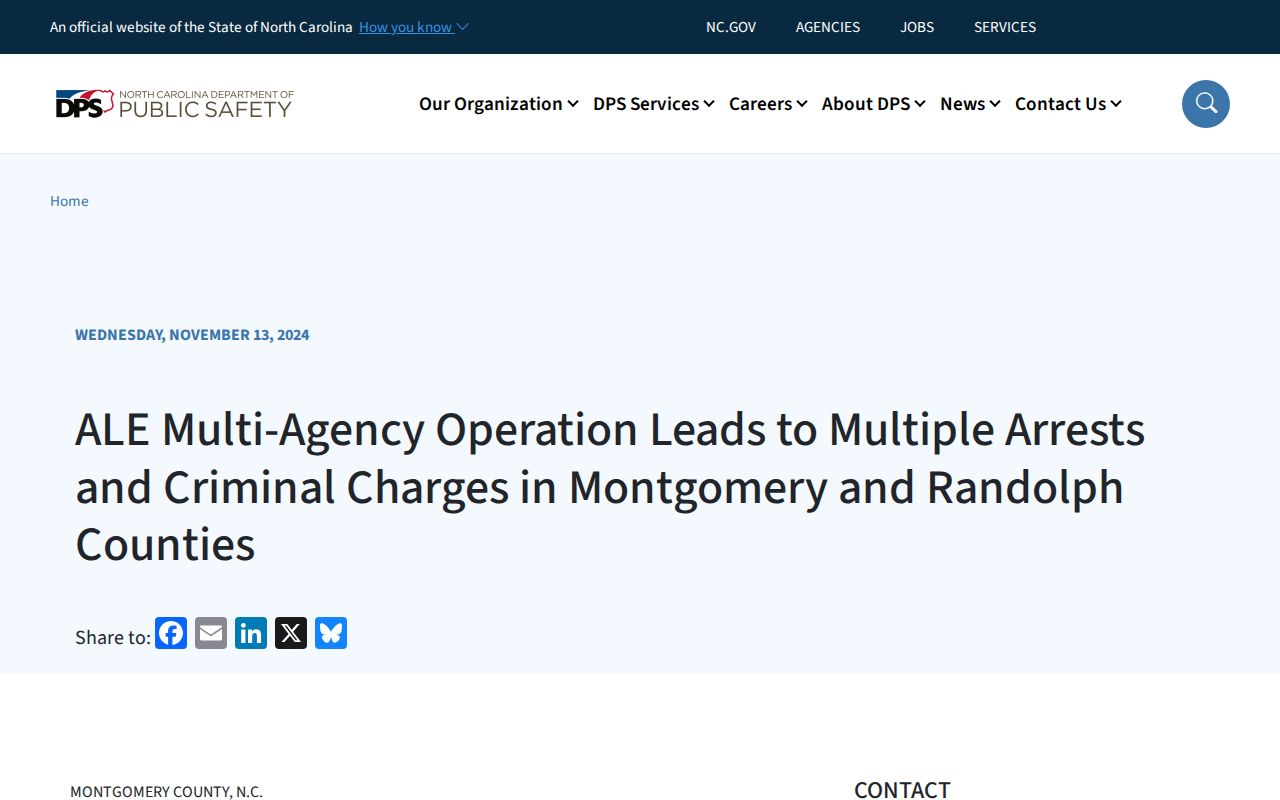
A release covers one event, not the roster. An NCSBI release from 2017 likewise described a historical operation spanning Montgomery County towns.
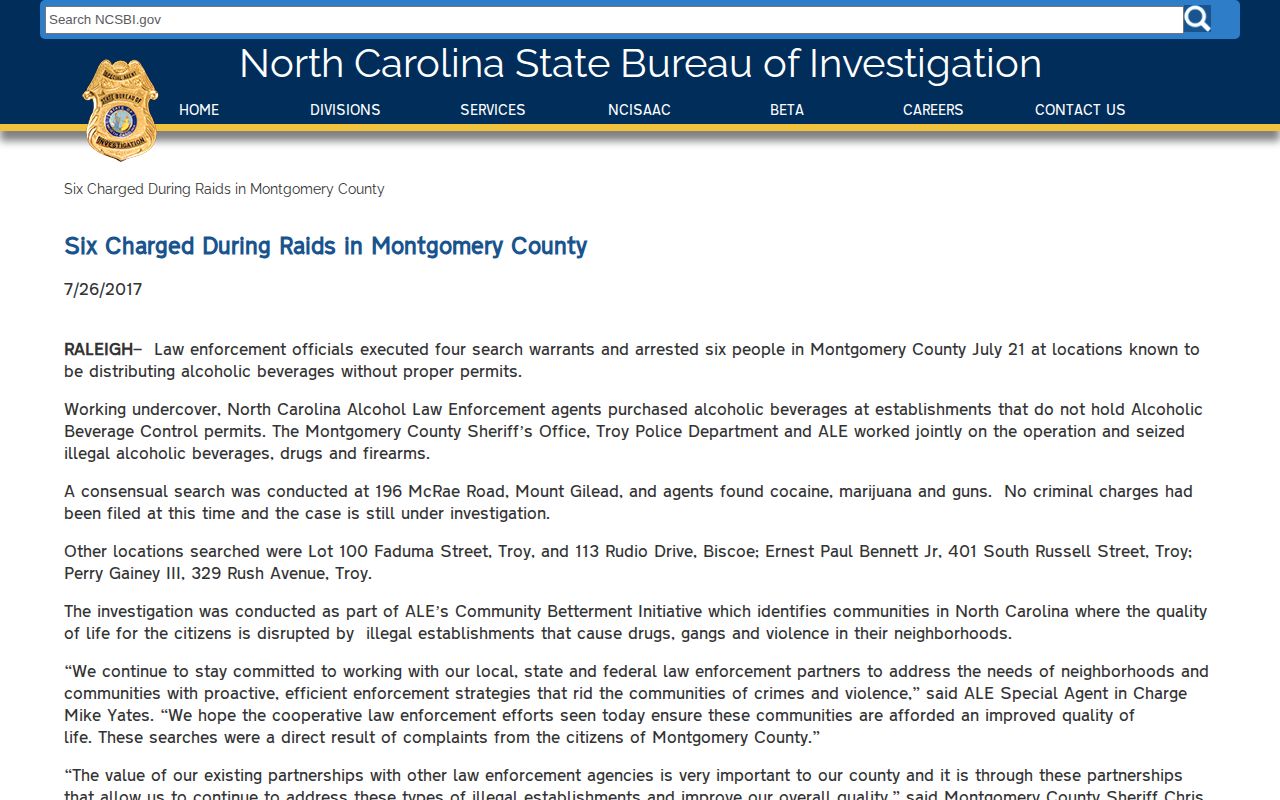
That older release makes the point clear. Official arrest reporting can hinge on one investigation and one publication date. Releases like it carry real authority. They speak only for the issuing agency. They are selective too, never listing every jail admission in a week. A joint operation also splits records across more than one agency.
Montgomery Herald Arrest Archive
The Montgomery Herald Sheriff's Reports section is the strongest local newspaper archive around. Its dated items carry labels like "Arrests, Criminal Summons." Coverage stretches across months and years. That proves recurring reporting, not a daily or weekly cadence. Editors pick which reports run, how each one is summarized, and whether a photo appears.
A newspaper date is a publication date. The event itself may be older. Open the article. Note its source language. Keep phrases like "charged" or "according to the report" close at hand. Then check the arresting agency and the court file. The Herald is not a live jail roster, and its archive cannot declare present custody.
News archives shine when a search spans weeks or years. They help especially after a current-status system stops showing the person. They stay secondary accounts. An omission may reflect editorial choice rather than an arrest that never happened.
Unofficial Montgomery Arrest History
Commercial sites sit outside the official record. RecentlyBooked keeps a Montgomery County page. It runs on a publisher-controlled 30-day window. The update times, fields, photos, and refresh claims all belong to that publisher rather than to any county promise. The RecentlyBooked Montgomery page illustrates the unofficial field layout and rolling format.
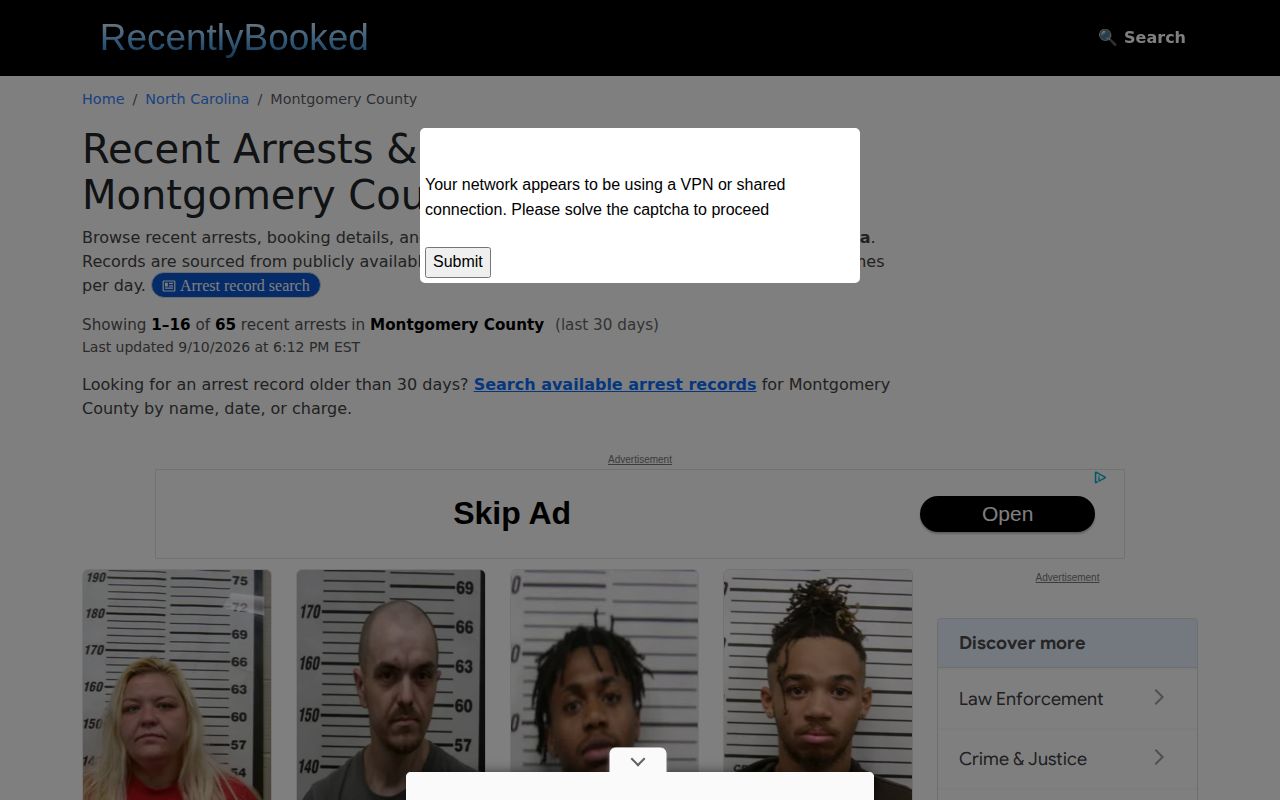
Other commercial archives work the same way. Busted Newspaper runs a county-local rolling archive for Montgomery. Arrests.org, Mugshots.zone, and Mugshots.com list no local page. Guessing at URLs, or swapping in a different Montgomery, only pulls in records for the wrong county. Any commercial listing can be incomplete or stale. It can also be duplicated, or tied to a charge that later changed. Confirm whatever you find with the jail, the agency, the clerk, and the court.
Montgomery Arrest Record Retention
A web window and a retention schedule answer different questions. North Carolina's Archives sets the schedule for sheriff records. Inmate incarceration records, including arrest sheets and entry or release summaries, are slated for destruction three years after release or transfer. The same three years covers unfiled ID photos. Solved felony case histories are kept twenty years. Most covered misdemeanor histories run three years. Audits, litigation, or other official action can suspend the normal destruction clock. These schedules govern records management. They are not online archives. Nothing in them promises that a requested arrest record still exists at the Sheriff's office. Start with the Sheriff or the arresting police department. For returned warrants, criminal summonses, and court files, call the Montgomery County Clerk of Superior Court at 910-571-3700. Older cases can lead to the Herald's newspaper archive or State Archives guidance.
A name can vanish from a 30-day publisher page while the agency record survives, and a commercial copy can linger after the official display ends. Ask the custodian whether the exact record was retained, transferred, lawfully destroyed, sealed, or placed on hold.
Montgomery Arrest Reports Need Context
An arrest report captures an agency action. It documents a booking, not a courtroom outcome. Details often shift afterward. Match names with care, note the source date, and keep "arrested," "booked," "charged," and "convicted" straight. Where sources conflict, the originating office and the court file deserve priority. The Montgomery County arrest hub lays out the countywide booking, court, and records channels in more depth.
Public Record Search
Sponsored Results